Article Plan: Fire Protection Guide to Hazardous Materials ⎼ PDF Free Download
This comprehensive article details navigating the Fire Protection Guide to Hazardous Materials, focusing on free PDF access, crucial resources like NFPA 1072, and HERO.
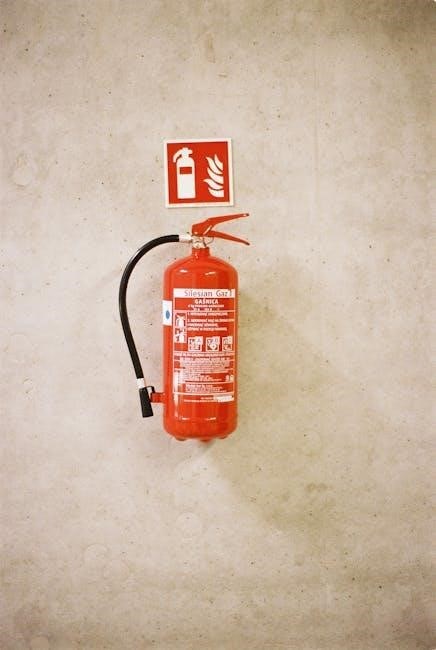
Effective fire protection concerning hazardous materials demands specialized knowledge. These substances pose unique risks beyond typical fires, requiring tailored strategies. The Fire Protection Guide to Hazardous Materials, published by the National Fire Protection Association (NFPA), is a cornerstone resource. It aids in identifying chemical properties and associated hazards, crucial for emergency responders.
Understanding these materials is paramount, as improper handling can lead to severe consequences – explosions, toxic releases, and environmental damage. Resources like the US Department of Transportation’s NFPA 1072 (Emergency Response Guidebook) complement the guide, offering immediate, on-scene guidance. This introduction sets the stage for a detailed exploration of these vital tools and procedures.
Importance of a Fire Protection Guide
A dedicated fire protection guide is indispensable when dealing with hazardous materials. Standard firefighting tactics are often insufficient and can even exacerbate the situation. The NFPA’s Fire Protection Guide to Hazardous Materials provides critical information for safe and effective response. It enables responders to quickly assess risks, select appropriate PPE, and implement targeted firefighting strategies.
This guide bridges the gap between general fire knowledge and the complexities of chemical behavior during incidents. It supports informed decision-making, minimizing harm to personnel, the public, and the environment. Access to this information, often via readily available PDF formats, is vital for preparedness and successful emergency management;
Understanding Hazardous Materials Classifications
Proper classification of hazardous materials is foundational for effective fire protection. The Fire Protection Guide relies heavily on standardized systems like the NFPA 704 diamond, providing a visual shorthand for key hazards. This system categorizes materials based on Health, Flammability, Reactivity, and Special hazards.
Understanding these categories—and the numerical ratings within each—allows responders to quickly gauge the severity of potential risks. The guide details how to interpret these classifications, linking them to appropriate response protocols. Accurate classification, facilitated by resources within the guide, is crucial for selecting the correct PPE and firefighting tactics.
NFPA 704 System (Diamond)
The NFPA 704 diamond is a globally recognized symbol for hazard identification. This color-coded system, detailed within the Fire Protection Guide, uses four quadrants to communicate critical information at a glance. Blue indicates Health hazards, Red signifies Flammability, Yellow represents Reactivity, and White denotes Special hazards.
Each quadrant contains a numerical rating from 0 to 4, with 4 representing the most severe hazard. The guide provides a comprehensive breakdown of what each number signifies within each category, enabling rapid risk assessment. Understanding this system is paramount for initial response and strategic decision-making.
Hazard Categories: Health, Flammability, Reactivity, Special
The Fire Protection Guide meticulously defines four key hazard categories. Health hazards detail the severity of short- or long-term exposure effects. Flammability ratings indicate the ease of ignition and fire spread. Reactivity assesses the substance’s potential for violent chemical reactions. Finally, the Special hazard section alerts to unique dangers like oxidizers or corrosive substances.
Each category utilizes the NFPA 704 system’s 0-4 scale. The guide clarifies specific health effects, flashpoints for flammability, and potential reactivity scenarios. This detailed categorization is crucial for selecting appropriate PPE and implementing effective firefighting strategies.
Key Resources for Hazardous Materials Information
Accessing reliable information is paramount when dealing with hazardous materials. The NFPA 1072, or Emergency Response Guidebook, developed collaboratively by US, Canadian, and Mexican transportation authorities, provides initial hazard assessments and response guidance.
Furthermore, the US Department of Transportation offers extensive resources, including hazardous materials regulations and incident reporting protocols. HERO (Health & Environmental Research Online), a US EPA resource, delivers detailed chemical properties and environmental impacts. Utilizing these resources, alongside the Fire Protection Guide, ensures informed decision-making during hazmat incidents.
NFPA 1072: Emergency Response Guidebook
The NFPA 1072, commonly known as the Emergency Response Guidebook (ERG), is a critical first responder tool. Developed jointly by the US Department of Transportation, Transport Canada, and Mexico’s Secretariat, it offers a rapid, on-scene hazard assessment.
The ERG categorizes hazardous materials by identification number and provides guidance on initial isolation, protective actions, and emergency contact information. It defines an “Endangered Area” as the potential exposure zone from a release. Regularly updated, the ERG is essential for safe and effective hazmat incident management, complementing the Fire Protection Guide.
US Department of Transportation Resources
The US Department of Transportation (DOT) plays a pivotal role in hazardous materials regulation and information dissemination. As a key developer of the NFPA 1072 Emergency Response Guidebook, DOT provides crucial resources for first responders and safety professionals.
Their website offers access to regulations, training materials, and incident reporting tools. These resources are vital for understanding proper handling, packaging, and transportation of hazardous materials. DOT’s commitment to safety ensures a coordinated national approach to hazmat incidents, working alongside organizations like NFPA to enhance preparedness and response capabilities.

The “Fire Protection Guide to Hazardous Materials” ⎼ Overview
The Fire Protection Guide to Hazardous Materials, published by the National Fire Protection Association (NFPA), is an essential resource for identifying and managing chemical hazards. This guide compiles information on a vast array of substances, aiding in safe response during emergencies.
It’s designed for firefighters, hazmat teams, and safety personnel, offering detailed chemical properties and potential risks. The guide utilizes systems like the NFPA 704 diamond to quickly assess hazards. Six NFPA documents comprise this guide, covering chemicals in commercial use and laboratory samples.
Editions and Updates of the NFPA Guide
The NFPA’s Fire Protection Guide to Hazardous Materials has undergone several editions, evolving with new chemical information and safety protocols. The 12th edition, released in 1997, was a significant iteration, providing updated data for a wider range of substances.
As of February 26, 2026, the current edition incorporates the latest research and regulatory changes. Notably, this edition features three new chemical matrixes, enhancing hazard identification. Staying current with these updates is crucial for effective emergency response and maintaining accurate safety protocols.
12th Edition (1997) ⸺ Key Features
The 1997, 12th edition of the Fire Protection Guide to Hazardous Materials represented a substantial advancement in hazmat response resources. It aimed to identify the hazardous properties of a vast array of chemicals, encompassing both commercially available substances and those found in laboratory settings.
This edition served as a foundational resource for firefighters and emergency responders, providing critical information for safe and effective incident management. While superseded by later versions, it established the guide’s core principle: comprehensive chemical data for informed decision-making during hazardous materials incidents.
Current Edition & Updates (as of 02/26/2026)
As of February 26, 2026, the Fire Protection Guide to Hazardous Materials continues to be updated with the latest chemical information and safety protocols. The current edition builds upon previous versions, incorporating new data sheets and refining existing hazard classifications.
Notably, the inclusion of three new chemical matrixes significantly enhances the guide’s usability. These matrices streamline the identification of chemical properties and associated risks. Regular updates ensure responders have access to the most current information, vital for mitigating hazards and ensuring effective emergency response.
Content of the Fire Protection Guide
The Fire Protection Guide to Hazardous Materials provides detailed information on a vast array of chemicals commonly encountered in commercial and laboratory settings. It meticulously outlines chemical properties, potential hazards, and appropriate response strategies.
A core component is the comprehensive coverage of chemical hazards, enabling responders to quickly assess risks. The guide’s strength lies in its ability to identify hazardous properties of substances, alongside the newly integrated chemical matrixes. These matrices offer a streamlined approach to understanding complex chemical data, improving safety and efficiency.
Chemical Properties & Hazards
This section delves into the specific characteristics of hazardous materials, crucial for effective fire and emergency response. It details physical states, reactivity, and potential health impacts, providing a foundation for risk assessment.
Understanding these properties – flammability, toxicity, corrosivity – is paramount. The guide clarifies how these characteristics influence fire behavior and exposure risks. It emphasizes the importance of recognizing potential hazards, including vapor density and explosion limits. This knowledge informs the selection of appropriate PPE and firefighting tactics, ensuring responder safety and minimizing environmental impact.
Chemical Matrixes – New Features
The latest editions of the Fire Protection Guide to Hazardous Materials introduce innovative chemical matrixes, significantly enhancing hazard identification. These matrices offer a streamlined approach to cross-referencing chemical names with their associated hazards and response strategies.
Unlike traditional methods, these matrixes provide a quick, visual overview of complex data. They facilitate rapid decision-making during emergencies, allowing responders to quickly assess risks and implement appropriate safety measures. The inclusion of these matrices represents a substantial improvement in the guide’s usability and effectiveness, offering a more intuitive and efficient resource.
Identifying Hazardous Properties
Accurately identifying hazardous properties is paramount when responding to incidents involving unknown materials. The Fire Protection Guide to Hazardous Materials equips responders with tools like the NFPA 704 system and detailed chemical information to assess risks.
Understanding health hazards, flammability levels, reactivity potential, and special considerations is crucial. Utilizing resources like Safety Data Sheets (SDS) alongside the guide provides a comprehensive understanding. Proper identification informs appropriate PPE selection and firefighting strategies, minimizing risks to responders and the public. This process demands diligent application of available resources and a systematic approach.
Firefighting Strategies for Specific Hazards
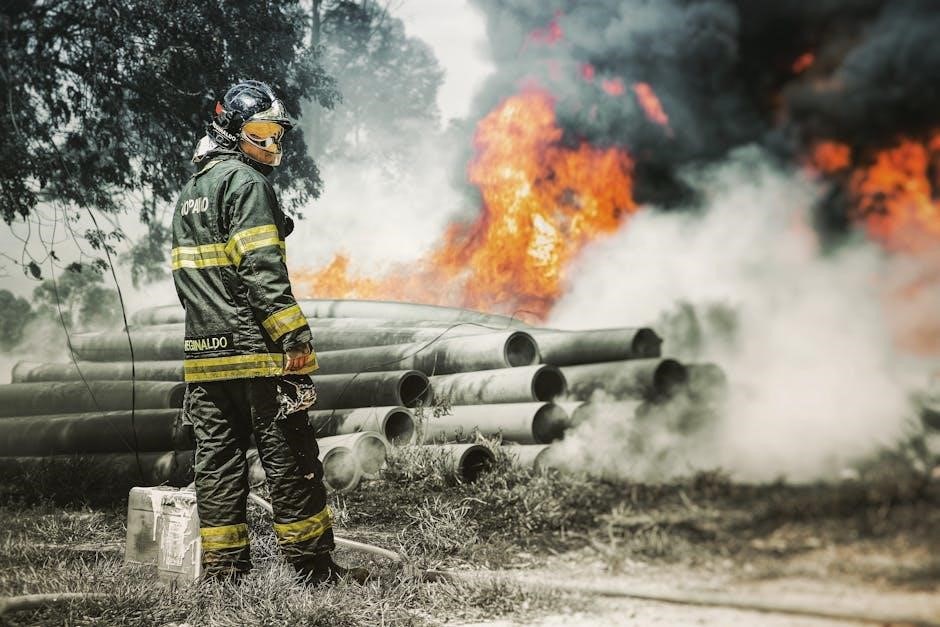
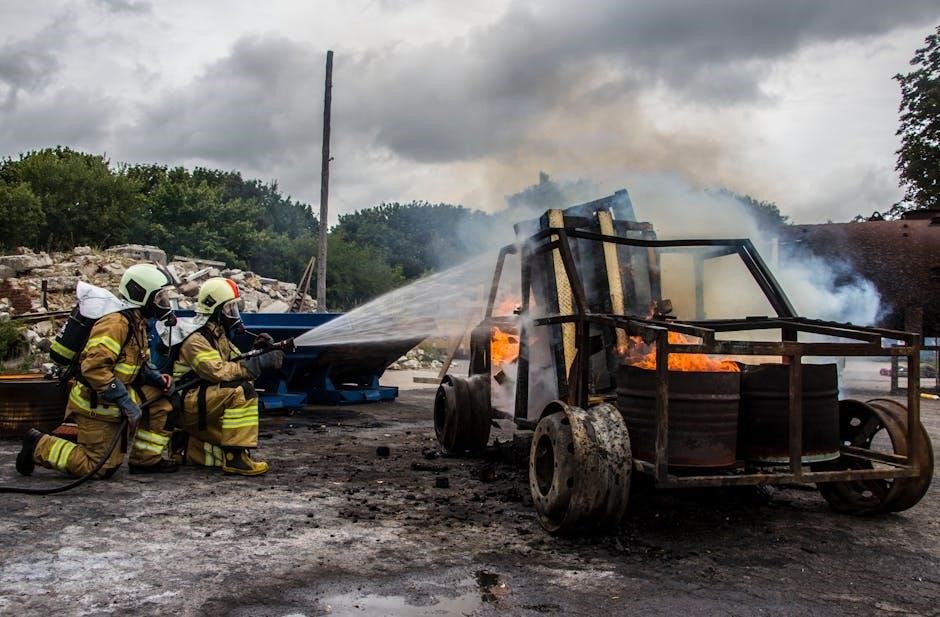
Effective firefighting demands tailored strategies based on the specific hazardous material involved. For flammable liquids, techniques prioritize cooling, foam application, and vapor suppression, preventing reignition. When confronting toxic gases and vapors, respiratory protection is non-negotiable, alongside establishing isolation zones and utilizing wind indicators.
The Fire Protection Guide to Hazardous Materials details these approaches, emphasizing the importance of understanding chemical properties. Responders must adapt tactics based on reactivity, potential for explosion, and environmental impact. Careful consideration of these factors ensures a safer and more effective response.
Flammable Liquids
Fighting fires involving flammable liquids requires a strategic approach focused on containment and cooling. Water spray can cool containers, creating a protective barrier, but direct application to the liquid itself is often ineffective and can spread the fire. Foam is highly effective, smothering the flames and preventing vapor release.
The Fire Protection Guide to Hazardous Materials emphasizes the importance of vapor suppression. Controlling ignition sources is paramount, alongside establishing a wide perimeter. Understanding the liquid’s flashpoint and autoignition temperature dictates the appropriate firefighting tactics, ensuring responder safety and minimizing environmental impact.
Toxic Gases & Vapors
Incidents involving toxic gases and vapors demand stringent respiratory protection and isolation procedures. The Fire Protection Guide to Hazardous Materials stresses the critical need for Level A personal protective equipment (PPE) – fully encapsulating suits with self-contained breathing apparatus (SCBA) – when dealing with unknown or highly hazardous substances.
Upwind positioning and continuous air monitoring are essential to prevent exposure. Evacuation of surrounding areas is often necessary. Understanding the specific toxicological properties of the gas or vapor, as detailed in Safety Data Sheets (SDS), informs appropriate decontamination protocols and medical treatment.
Personal Protective Equipment (PPE) for Hazmat Incidents
Selecting appropriate Personal Protective Equipment (PPE) is paramount during hazardous materials incidents. The Fire Protection Guide to Hazardous Materials emphasizes a tiered approach, ranging from basic levels like awareness-level PPE (gloves, eye protection) to more advanced levels.
Level A provides the highest level of protection – a fully encapsulating suit with SCBA – for unknown or highly dangerous substances. Level B utilizes a non-encapsulating suit with SCBA. Levels C and D offer decreasing levels of respiratory and skin protection. Proper training in donning, doffing, and decontamination procedures is crucial to prevent exposure and ensure effectiveness.
Emergency Response Procedures
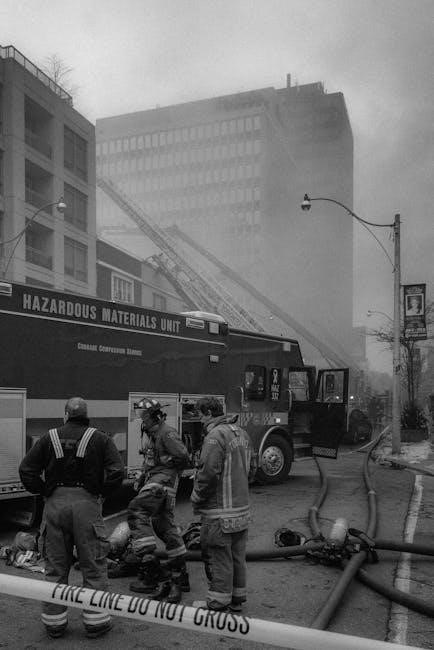
Effective emergency response to hazardous materials incidents demands a systematic approach. Initial actions involve scene assessment, identifying the substance (utilizing resources like NFPA 1072), and establishing an endangered area to protect responders and the public.
The Fire Protection Guide to Hazardous Materials stresses the importance of isolation, containment, and proper ventilation. Evacuation procedures must be clearly defined and implemented. Communication is vital – relaying information to dispatch and other responding agencies. Decontamination protocols are essential to prevent secondary contamination, and thorough documentation of all actions is required.
Utilizing HERO (Health & Environmental Research Online)
HERO (Health & Environmental Research Online), a US EPA resource, is invaluable for hazmat incident response. It provides rapid access to critical information regarding the health effects, environmental fate, and safe handling of numerous hazardous substances.
Users can quickly locate data on chemical properties, toxicity, and recommended protective actions. HERO complements the Fire Protection Guide to Hazardous Materials by offering detailed substance profiles. Accessing HERO allows responders to make informed decisions, mitigating risks and ensuring appropriate safety measures are implemented during emergencies. It’s a crucial tool for comprehensive hazard evaluation.
Legal and Regulatory Framework
Compliance with legal and regulatory standards is paramount when handling hazardous materials. OSHA (Occupational Safety and Health Administration) regulations dictate workplace safety protocols, including hazard communication and PPE requirements for hazmat incidents.
Furthermore, EPA (Environmental Protection Agency) guidelines govern the proper handling, storage, and disposal of hazardous substances to minimize environmental impact. The Fire Protection Guide to Hazardous Materials assists in adhering to these regulations by providing essential information for risk assessment and emergency response planning. Understanding these frameworks ensures legal compliance and protects both personnel and the environment.
OSHA Regulations
OSHA’s Hazard Communication Standard (HCS) is central to hazmat safety, mandating employers to inform employees about chemical hazards through SDS (Safety Data Sheets) and proper labeling. Regulations cover PPE selection, respiratory protection, and emergency response training.
Specific OSHA standards address fire protection, including fire prevention plans and fire brigade requirements. The Fire Protection Guide to Hazardous Materials aids in fulfilling these obligations by providing detailed hazard information. Compliance with OSHA regulations minimizes workplace risks and ensures a safe environment for handling dangerous substances, protecting employees from potential harm.
EPA Guidelines
The Environmental Protection Agency (EPA) provides crucial guidance on managing hazardous materials, focusing on preventing releases and mitigating environmental impact. Resources like HERO (Health & Environmental Research Online) offer extensive chemical data and risk assessments.
EPA regulations, including those under the Resource Conservation and Recovery Act (RCRA), govern the handling, storage, and disposal of hazardous waste. The Fire Protection Guide to Hazardous Materials complements these guidelines by detailing chemical properties and potential environmental hazards. Adhering to EPA standards is vital for protecting ecosystems and public health during hazmat incidents.
Where to Find Free PDF Downloads (Legitimate Sources)
Locating a free, legitimate PDF of the Fire Protection Guide to Hazardous Materials requires careful sourcing. While a complete, current edition may not be universally free, the National Fire Protection Association (NFPA) occasionally offers previews or older editions.
Government resources, like the US Department of Transportation, provide access to related documents such as NFPA 1072 (Emergency Response Guidebook). Internet Archive may host older versions. Always verify the source’s authenticity to avoid outdated or compromised information. Be cautious of websites promising free downloads, as they may contain malware.
Potential Risks of Downloading from Unofficial Sources

Downloading the Fire Protection Guide to Hazardous Materials from unofficial sources presents significant risks. These PDFs may be outdated, lacking crucial updates regarding chemical properties and emergency procedures, potentially leading to incorrect responses during incidents.
Unofficial sites frequently harbor malware, viruses, and other malicious software, compromising your device and data security. Copyright infringement is also a concern. Relying on inaccurate information could endanger responders and the public. Always prioritize legitimate sources like the NFPA or government websites to ensure access to current, reliable, and safe information.
Understanding Endangered Areas (NFPA 1072)
NFPA 1072, the Emergency Response Guidebook, defines an “Endangered Area” as the actual or potential zone of exposure following a hazardous materials release. This area dictates evacuation zones and protective action radii, crucial for responder and public safety.
Determining the endangered area requires identifying the substance, quantity released, and prevailing environmental conditions. The guidebook provides initial isolation and protective action distances, but these are estimates. Accurate hazard assessments, utilizing the Fire Protection Guide and SDS information, are vital for defining the true extent of the endangered area and implementing appropriate mitigation strategies.

Chemical Data Sheets (SDS) and Their Role
Safety Data Sheets (SDS) are fundamental to hazardous materials response, providing detailed information about a substance’s properties, hazards, and safe handling procedures. They complement the Fire Protection Guide by offering specific data not always found within the guide’s matrices.
SDS sections cover identification, hazards, composition, first-aid, firefighting measures, accidental release protocols, handling/storage, exposure controls, and physical/chemical properties. Accessing SDS information before and during an incident is critical for selecting appropriate PPE, implementing effective control measures, and protecting responders and the public. They are essential for informed decision-making.
Training and Certification for Hazmat Response
Effective hazardous materials response demands specialized training and certification. Personnel must understand hazard recognition, risk assessment, PPE selection, and decontamination procedures, all informed by resources like the Fire Protection Guide.
Levels of training, often aligned with OSHA regulations (29 CFR 1910.120), range from awareness to specialist. Awareness-level training introduces basic hazards, while operations-level focuses on defensive strategies. Technician-level personnel mitigate releases, and specialists manage complex incidents. Certification demonstrates competency and adherence to national standards, ensuring responders are adequately prepared to handle emergencies safely and effectively.
Case Studies: Real-World Hazmat Fire Incidents
Analyzing past hazmat fire incidents provides invaluable lessons for improving response strategies. Examining events involving flammable liquids, toxic gases, or reactive chemicals highlights the critical need for accurate hazard identification – utilizing resources like the Fire Protection Guide.
Case studies reveal common errors, such as inadequate PPE, improper ventilation, or delayed evacuation. They demonstrate the importance of understanding chemical properties, endangered areas (as defined by NFPA 1072), and the role of SDS information. Learning from these real-world scenarios strengthens preparedness and minimizes risks during future emergencies.
Staying Informed and Prepared
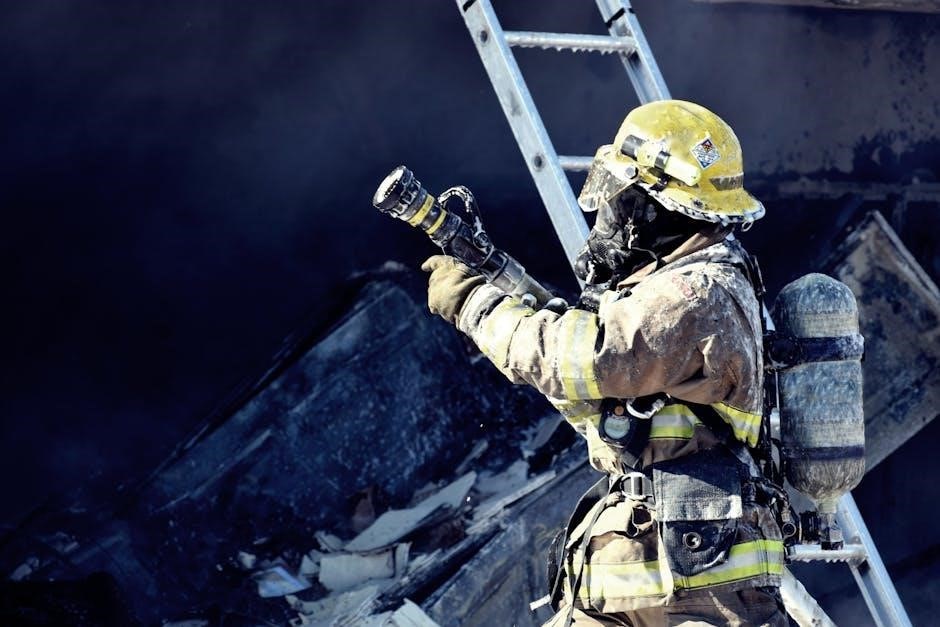
Proactive engagement with resources like the Fire Protection Guide to Hazardous Materials is paramount for effective emergency response; Regularly updating knowledge on hazardous material classifications, utilizing tools like HERO (Health & Environmental Research Online), and understanding NFPA standards are crucial.
Accessing legitimate PDF downloads ensures reliance on current, accurate information. Continuous training and certification for hazmat response, coupled with awareness of OSHA and EPA guidelines, builds a robust safety framework. Prioritizing preparedness minimizes risks and safeguards responders and the public.